
Your AI-Generated Poster Looks Like Shit
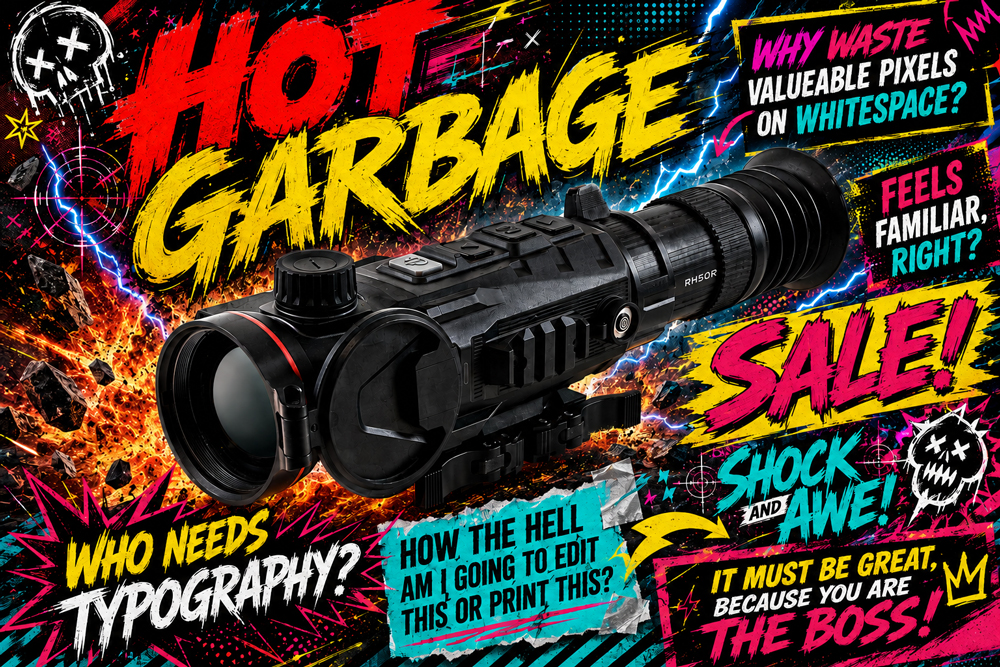
It takes about eleven seconds. You type a descriptive prompt into a prompt box, hit enter, and watch a high-resolution poster materialize on your screen. But while it feels like fast, cheap, and easy success, your target audience sees something completely different.
It’s cinematic. It’s vibrant. It features a glowing neon overlay, dramatic volumetric lighting, and enough intricate detail to make a renaissance painter sweat. In that moment, you get a hit of pure dopamine. You had an idea in your head at 9:00 AM, and by 9:01 AM, it exists in visual form. You went from zero to sixty in a single click, and because you're moving fast, it feels like success. Fast, cheap, and easy—the holy trinity of business efficiency that usually forces you to pick two now feels available all at once. Naturally, your first instinct is to hand it off to marketing, throw it on a trade show banner, or print it out for your next big product announcement. To you, the creator, it looks incredible. But to your target audience? It looks like absolute trash.
The Illusion of Design Expertise
The ultimate trap of generative AI is how dangerously appealing it is to non-designers. If you don't come from a visual communications background, a raw AI output looks like a fully realized, professional design. But there is a massive difference between a piece looking busy and a piece being designed. Without foundational design knowledge, you don't know the right questions to ask. You don't know what typography is appropriate for your industry. You don't know if the visual hierarchy guides the eye or completely derails it.
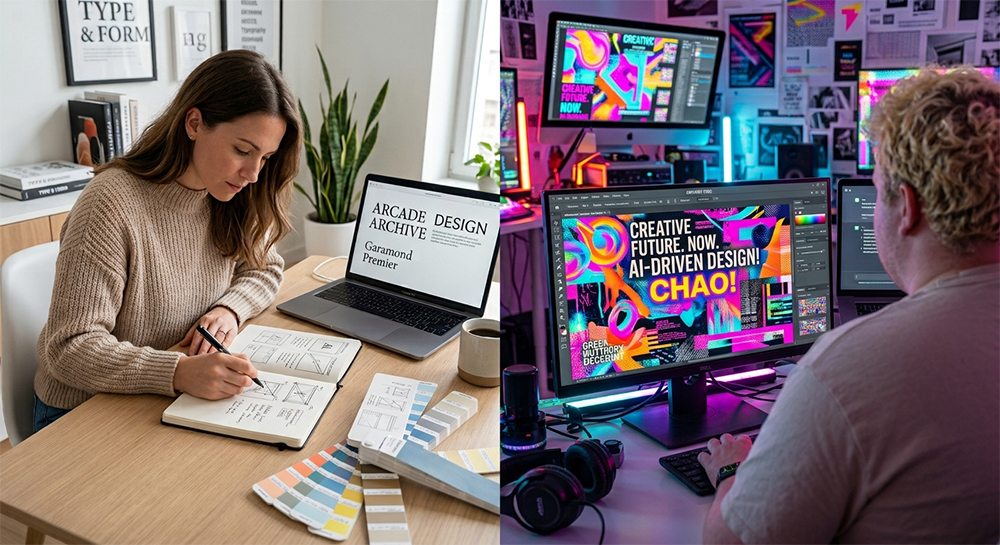
Generative tools eliminate the friction of execution overnight, giving founders and managers the illusion that they have bypassed the creative process entirely. You see your concept brought to life instantly, and because you engineered the prompt that birthed it, you are emotionally invested in the output. Speed is not strategy, and velocity is not execution. When you mistake a ten-second render for a finished marketing asset, you aren't saving money—you’re eroding your brand's authority.
The Microwave Kitchen: Painting a Brand Lie
Underneath the speed and convenience lies the most dangerous aspect of AI-generated marketing assets: it paints a brand lie. It is completely inauthentic to who you actually are. When a small business uses hyper-polished, over-rendered AI artwork, they aren't establishing a brand identity—they are projecting a facade they lack the actual expertise, craft, or skill to maintain.
The Microwave Analogy: It’s like walking into a high-end restaurant with mood lighting, crisp white tablecloths, and glowing candles, only to realize the kitchen has zero chefs and is staffed entirely by people running industrial microwaves. Every dish is a pre-packaged, frozen meal that’s just been heated up and plated. It might technically be food, but the moment the customer bites into it, the illusion vanishes—and they know they’ve been sold a cheap trick.
That is the exact reality of relying on AI design. You might feel like you've hacked the system by getting fast, cheap, and easy visuals all at once, but the tradeoff is quality and authenticity. Because you don't own the underlying skill or creative strategy, you can't build on it. You can't iterate on that brand image systematically, align it across all customer touchpoints, or maintain a cohesive campaign. The second a customer digs one millimeter beneath the surface, the whole facade crumbles.
Why Your Audience Is Already Exhausted by It
You might be seeing that generated poster for the first time, but your customers have already seen it a thousand times today. Generative image models feed on the exact same pool of internet visual tropes. As a result, every AI-generated graphic shares the same unmistakable visual DNA: hyper-dense details, weirdly glossy surfaces, uncanny lighting, and an absurdly cluttered composition. To the average consumer, your poster isn't striking—it's digital noise.
- It looks generic: Without intentional composition, AI fills every blank pixel with random visual artifacts to simulate "complexity."
- It looks thoughtless: Because nothing on the canvas was placed there with purpose, the image conveys zero deeper meaning or story.
- It feels exhausting: When everything in an image is cranked to maximum saturation and detail, the eye has nowhere to rest. It becomes visual sludge.
Your audience doesn't look at that graphic and think, "Wow, what an innovative company." They look at it, recognize the telltale signs of Midjourney or DALL-E within half a second, and register your brand as cheap, lazy, and unoriginal.

10,000 Lightbulbs: Where AI Actually Shines
Does AI have a place in the future of creative work? Absolutely, but its power is restricted to the sandbox, not the final showroom. AI is an extraordinary engine for concepting. It allows you to rapidly explore dozens of creative directions in a single afternoon and figure out what doesn't work at zero cost. Think of Thomas Edison’s famous mindset on finding 10,000 ways not to make a lightbulb—AI lets you burn through those 10,000 dead ends in a matter of minutes so you can finally zero in on the one strategic direction worth pursuing.
It’s a world-class tool for rapid brainstorming, mapping mood boards, and testing wild ideas before committing production dollars. But there is a sharp divide between rapid concepting and finished design. AI is brilliant at generating raw ideas; it is horrifyingly bad at final execution. Treating an ideation prototype as a market-ready asset is where companies stumble.
AI Belongs in the Kitchen: As a Sous-Chef, Not the Head Chef
To make AI work for your brand, you have to assign it the right job description. Think of it as a digital sous-chef. A master chef doesn't hand off the entire menu, recipe creation, and plating strategy to the guy prepping vegetables in the back. They use the sous-chef to chop the onions, mix a base sauce, or prep raw ingredients so the final dish can be crafted with precision.

In a professional design workflow, AI operates the exact same way. It is a fantastic tool for generating a custom texture, creating a specific digital brush, building a subtle background element, or powering that early concepting phase. But you never let the AI control the whole canvas, and you certainly don't let it sign its name to the final asset.
Tools Change, But Real Intelligence Doesn't
At its core, the entire concept of design has never been about the mechanical process of making art. The physical act of putting marks on a canvas has always been handled by a tool—whether that tool was a horsehair brush, a Gutenberg printing press, a darkroom enlarger, or a vector program on a Mac. AI is simply the newest, fastest tool in the shed.
The actual design work isn't the rendering; it’s the thought process. It is the real intelligence, not the artificial intelligence. Design is the deliberate, strategic choice of why an element exists on the page. It's knowing when to remove a graphic to let a headline land. It's selecting typography that reflects your brand's tone rather than whatever chaotic, stylized text an algorithm threw together. It's understanding your audience deeply enough to evoke a specific human response. AI can mimic pixels, but it cannot mimic intent.
The Reality Check
Generative AI is a remarkable force multiplier when kept in its proper place. Use it heavily in the backroom to explore directions, run through your 10,000 lightbulb tests, build raw textures, or hand a rough mood board over to a creative director. But the moment a graphic represents your business to the outside world, the shortcut ends.
Your brand identity isn't built on how fast you can generate pixels—it’s built on intentionality, clarity, authenticity, and standing out from the crowd. If your marketing visuals look like every other generic prompt dump on the internet, don't be surprised when your customers scroll right past you. Clear the clutter, put real intelligence back into your creative direction, and give your audience something worth looking at.